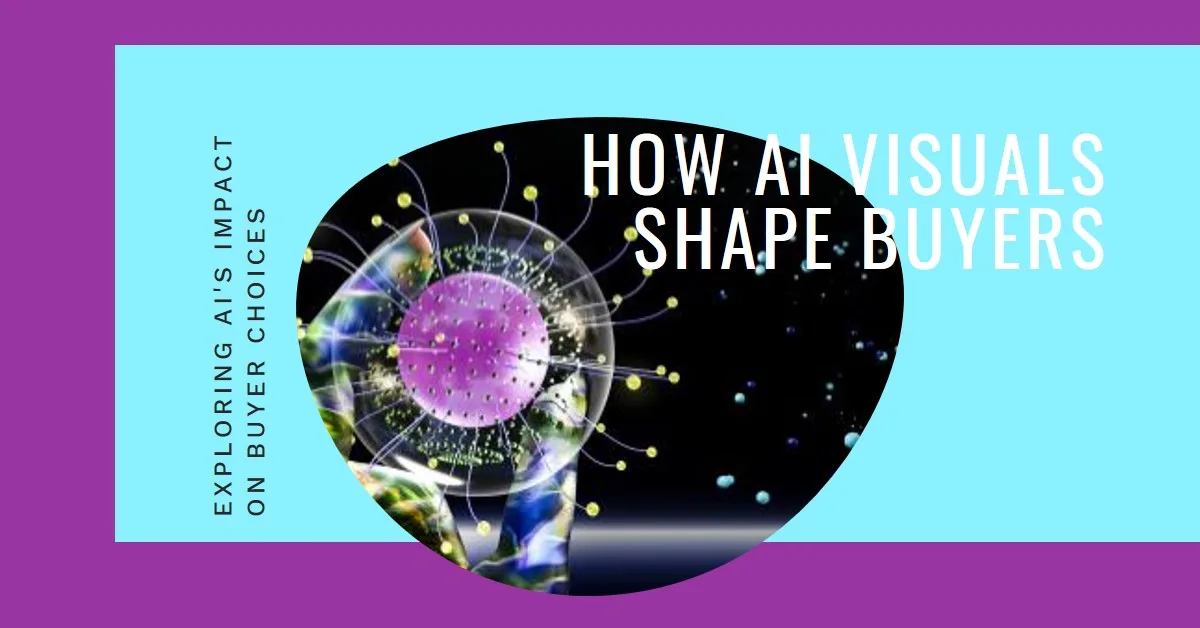
Understanding the psychology of visuals and how AI designs influence buyer behaviour has become essential for businesses competing in 2025’s digital marketplace. Your brain processes images 60,000 times faster than text, making visual content the first thing customers notice about your brand. When combined with artificial intelligence, visual design becomes even more powerful—AI now analyses millions of data points to determine which colours, layouts, and images trigger specific emotional responses that drive purchases. Nearly three-quarters of consumers trust brands more when visuals are consistent across platforms, and 85% of shoppers admit that colour alone influences their buying decisions. This article explores the psychology of visuals and how AI design influences buyer behaviour, revealing the science behind why specific images make you click “buy now”. In contrast, others go ignored, and show businesses exactly how to leverage AI-powered design to boost conversions and build lasting customer relationships.
Why Visual Psychology Matters More Than Ever
Before exploring how AI design influences buyer behaviour through visual psychology, let’s understand why visuals have such a profound impact on our purchasing decisions.
The human brain is fundamentally visual. We process images thousands of times faster than we process words, and we remember visual information far longer than text-based content. It isn’t just interesting trivia—it’s the foundation of the psychology of visuals and how AI designs influence buyer behaviour in commercial settings.
Research reveals that it takes just 0.05 seconds—half a tenth of a second—for someone to judge your website. In that fraction of a moment, before anyone reads your mission statement or explores your products, visitors decide whether your brand looks trustworthy, professional, and worth their time.
The stakes are high, but well-designed websites foster trust and confidence, helping your brand stand out amid the AI-generated content flood in 2025 and reassuring businesses of their competitive edge.
Colours send powerful psychological signals—urgency, calmness, trust, excitement—that can inspire marketers to craft visuals that evoke immediate emotional responses, driving action effectively.
Understanding How Our Brains Process Visual Information
The psychology of visuals and how AI designs influence buyer behaviour begins with understanding how the human brain actually processes images and makes split-second judgments.
Cognitive Biases and Visual Shortcuts
Our brains rely on mental shortcuts, called cognitive biases, to make quick decisions without analysing every detail. When you see a product image, your brain doesn’t methodically evaluate every element—instead, it uses these shortcuts to form instant impressions.
The halo effect means that if one aspect of a visual looks good, we assume the rest of it is good too. Professional product photography makes customers believe the product is high quality, even before reading the specifications. It explains why businesses invest thousands in photography—the psychology of visuals and how AI-designed visuals influence buyer behaviour — and leverages these automatic assumptions.
Social proof bias drives us to follow what others do. When product displays “trending” labels or “bestseller” badges, we’re more likely to purchase because our brains interpret popularity as validation. AI can now identify which social proof signals work best for specific customer segments.
Emotional Triggers in Visual Content
Images trigger emotional responses faster than rational thought. It is crucial for understanding the psychology of visuals and how AI design influences buyer behaviour—purchases are emotional decisions we rationalise afterwards, not logical calculations.
Facial expressions in images create powerful emotional connections. Studies show that people connect more with visuals that feature genuine emotions like joy, surprise, or empathy. A picture of someone naturally smiling evokes positive emotions and encourages engagement, while emotionless or artificial-looking photos fail to create meaningful connections.
Colour also functions as emotional language. Red creates urgency and excitement, making it perfect for clearance sales. Blue fosters trust and calm, which is why financial institutions favour it. Green signals health and environmental consciousness, appealing to eco-aware consumers. Understanding these colour-emotion connections is fundamental to the psychology of visuals and how AI designs influence buyer behaviour.
How AI Is Revolutionising Visual Design
Artificial intelligence has transformed how businesses create, test, and optimise visual content, but it also raises ethical considerations around manipulating emotional responses. The psychology of visuals and how AI-designed visuals influence buyer behaviour has become increasingly sophisticated as AI tools analyse massive datasets to predict which designs will perform best, prompting discussions about responsible use.
AI-Powered Colour Psychology
AI can now predict which colour combinations will evoke specific emotions in target audiences. Rather than guessing which colours might work, businesses use AI-driven colour analytics to ensure designs elicit precise emotional responses.
Machine learning algorithms analyse millions of successful designs across industries, identifying patterns in colour usage that correlate with higher conversion rates. These systems can recommend optimal colour palettes based on your industry, target demographic, product type, and desired emotional response.
In 2025, expect more brands to trademark their colours and build product lines around signature hues. Visual branding is evolving from a design choice to an intellectual property strategy, and AI helps brands identify underutilised colour spaces to establish distinctive visual identities.
Dynamic Personalisation at Scale
One of the most powerful applications of the psychology of visuals and how AI designs influence buyer behaviour is personalisation. AI adjusts visual elements in real time based on individual user behaviour, preferences, and demographics.
When you visit an e-commerce site, AI might show you product images featuring models who match your demographic profile. These colours align with your past preferences or layouts optimised for your browsing patterns. This personalisation happens instantly, creating experiences that feel custom-designed for each visitor.
Retailers using predictive analytics report 25% increases in conversion rates and 30-40% better campaign ROI thanks to well-timed, AI-driven visual interventions. Understanding how to measure the success of these strategies, such as tracking engagement, conversion metrics, and emotional response data, can help marketers optimise their use of AI in visual psychology.
Generative AI for Custom Visuals
Generative AI creates unique, custom visuals that would be impossible or prohibitively expensive with traditional design methods. Understanding the psychology of visuals and how AI-designed visuals influence buyer behaviour means recognising that custom visuals deliver 7x better performance than generic stock photography.
Platforms like Midjourney, DALL-E, and Stable Diffusion generate original images from text descriptions. Businesses can create unlimited product visualisations, lifestyle images, and promotional graphics without photoshoots or graphic designers.
The authenticity question matters here. While AI can generate visuals, audiences increasingly demand real, authentic imagery. The psychology of visuals and how AI designs influence buyer behaviour in 2025 requires balancing AI efficiency with genuine authenticity—using AI to enhance rather than replace authentic visual storytelling.
The Rule of Three in Visual Merchandising
One of the most powerful concepts in the psychology of visuals and how AI designs influence buyer behaviour is the Rule of Three, which suggests that items grouped in threes create more aesthetically pleasing and memorable arrangements.
Research shows that over 80% of customers agree that their buying decisions are influenced by product displays, with grouped arrangements being particularly effective. The Rule of Three works because it creates natural balance—three items form an asymmetrical arrangement that’s visually interesting without appearing cluttered.
It’s also cognitively manageable—three options provide enough variety for comparison without overwhelming shoppers. And it’s inherently memorable—the human brain naturally processes and remembers information presented in threes more effectively than other quantities.
AI can optimise the Rule of Three by analysing which product combinations work best together. When you incorporate personalisation into this strategy—tailoring the product trio to individual customer preferences—you not only enhance engagement but also significantly boost conversion likelihood.
Visual Storytelling and Brand Narrative
The psychology of visuals and how AI designs influence buyer behaviour extends beyond individual images to sequential visual storytelling that guides customers through memorable experiences.
Creating Visual Narratives
People remember stories better than plain facts, and images bring stories to life. Brands using visual storytelling in their marketing capture attention and leave lasting impressions more effectively than text-heavy approaches.
Sequential design elements arrange visuals to guide viewers through clear journeys. Emotive imagery evokes relatable emotions, building connections. Symbolism and metaphors reinforce brand narratives through subtle design choices.
For example, a sustainable clothing brand might use images of artisans crafting garments by hand, nature-inspired backgrounds, and earth-toned colour palettes to tell a cohesive story of environmental commitment. This visual narrative conveys values more quickly and memorably than paragraphs of text about sustainability practices.
Consistency as a Trust Signal
Consistency is absolutely critical to the psychology of visuals and how AI designs influence buyer behaviour. Nearly three-quarters of consumers trust brands more when visuals are consistent—not just logo placement, but also tone, typography, spacing, and style that stay the same across all touchpoints.
In 2025, visual consistency is increasingly tied directly to growth, loyalty, and conversions. Brands investing in visual psychology today build more than aesthetics—they’re building equity that compounds over time as recognition strengthens.
AI helps maintain this consistency automatically. Once you establish brand guidelines, AI tools can apply colours, fonts, and style elements consistently across thousands of designs without manual oversight, ensuring every customer touchpoint reinforces the same visual identity.
Typography and Emotional Communication
Typography is more than font choice—it’s a powerful communicator of mood and emotion. Understanding the psychology of visuals and how AI designs influence buyer behaviour requires recognising how typefaces shape perception.
Bold, sans-serif fonts communicate modernity, strength, and clarity. They work well for tech brands and products, emphasising innovation. Serif fonts convey tradition, reliability, and sophistication, making them popular for luxury brands and financial institutions. Script fonts suggest elegance and creativity, but can reduce readability if overused.
AI-powered typography tools now analyse how different fonts perform with specific audiences. They can recommend optimal font combinations for headers, body text, and calls to action based on industry benchmarks and your brand personality.
The spacing, size, and weight of typography also matter tremendously. Proper hierarchy guides the eyes through the content in the intended order, emphasising key messages while maintaining readability. AI can optimise these elements faster than human designers, testing thousands of variations to identify the most effective typographic treatments.
Product Visualisation and Virtual Try-On
One of the most transformative applications of the psychology of visuals and how AI designs influence buyer behaviour is virtual product visualisation powered by augmented reality and AI.
Generative AI enables consumers to try on products virtually through AR and VR. Virtual shopping assistants can simulate trying on clothes, accessories, or visualising furniture in your home. By generating virtual representations of products on consumers’ bodies or in their living spaces, generative AI enhances visualisation and evaluation.
This addresses one of e-commerce’s most significant challenges—the inability to interact with products before purchase physically. When customers can visualise products in their own context, confidence in purchasing decisions increases dramatically, reducing return rates while improving conversion rates.
The psychology of visuals and how AI-designed visuals influence buyer behaviour shows that seeing products in a personal context creates emotional ownership before purchase. You’re not just looking at a couch—you’re seeing your couch in your living room, which fundamentally changes the buying decision from abstract to concrete.
The Power of User-Generated Content
While professional visuals are essential, user-generated content (UGC) represents another crucial aspect of the psychology of visuals and how AI designs influence buyer behaviour in authentic ways.
Authenticity has become the new currency in marketing, and visuals are where authenticity begins. Custom images, illustrations, and video assets make brands feel intentional and human. When you use overused stock photos, audiences spot them instantly—it feels generic and disengaging.
That’s why custom visuals drive 7x better performance than stock imagery. In the future, brands will need to invest in design workflows allowing for fast, on-brand custom content creation, and we’ll see more brands using AI to generate visuals that are both unique and scalable.
UGC provides authenticity at scale. When real customers share photos of themselves using products, these images carry more psychological weight than professional photography because they demonstrate genuine social proof. People are naturally drawn to faces and real-life scenarios more than polished studio shots.
AI can curate and optimise UGC by identifying which customer photos are most likely to drive conversions based on composition, lighting, emotional expression, and context. It helps brands showcase the most effective authentic content without manually sorting through thousands of submissions.
Measuring Visual Performance
Understanding the psychology of visuals and how AI designs influence buyer behaviour requires systematic measurement of which visual approaches actually drive results.
Key Metrics to Track
Click-through rate (CTR) measures whether people are clicking your ads or product links—a higher CTR indicates visuals successfully capture attention and generate interest. Conversion rates indicate whether viewers complete desired actions, such as purchasing, signing up, or requesting information, after engaging with visuals.
Heatmaps show where eyes linger on pages, letting you identify which visual elements attract attention and which get ignored. Tools like Hotjar reveal exactly where users look, click, and scroll, providing insights that inform design improvements.
Bounce rates indicate whether visuals engage visitors or drive them away. High bounce rates despite good traffic suggest visual design problems that create negative first impressions.
A/B Testing Visual Elements
Testing different visual approaches reveals what actually works for your specific audience. A/B test different product images, colour schemes, layouts, typography choices, and call-to-action button designs to identify optimal combinations.
The psychology of visuals and how AI designs influence buyer behaviour varies by industry, demographics, and product type. What works for luxury fashion differs dramatically from what works for budget electronics. Systematic testing reveals your unique visual formula.
AI accelerates this testing by running multiple variations simultaneously and identifying winners faster than traditional sequential testing. Machine learning algorithms can predict which untested variations are likely to perform well based on patterns from previous tests.
Accessibility and Inclusive Design
The psychology of visuals and how AI designs influence buyer behaviour must include accessibility—ensuring that designs work for everyone, including people with visual impairments, colour blindness, and other disabilities.
Accessible design isn’t just ethical—it expands audience reach and brand impact. Approximately 15% of the global population experiences some form of disability, representing a massive market that inaccessible designs exclude.
AI helps identify and automatically fix accessibility issues. Tools can check colour contrast ratios, suggest alternative text for images, ensure adequate font sizes, and identify navigational problems that might frustrate users with disabilities.
Moreover, accessibility-optimised designs often improve experiences for all users. Clear contrast, readable fonts, and logical layouts benefit everyone, not just those with specific accessibility needs.
Emerging Technologies Shaping Visual Psychology
The psychology of visuals and how AI designs influence buyer behaviour continues to evolve as emerging technologies create entirely new ways for brands and consumers to interact visually.
Augmented and Virtual Reality
AR and VR let users “step into” brand experiences—trying on clothes virtually, touring hotel rooms before booking, or visualising furniture in their homes before purchasing. These immersive visual experiences create emotional connections impossible with traditional photography.
Biometric feedback could alter visuals in real-time, matching user emotions on the spot. Imagine ads that adjust colour schemes based on your emotional state detected through facial recognition or heart rate monitoring, creating perfectly optimised psychological experiences.
AI-Generated Dynamic Content
Generative AI can quickly create personalised images for each viewer, with even dynamic banners that react to mouse movements or user behaviour, keeping attention levels high. It moves beyond static design into responsive visual experiences that adapt moment by moment.
Neural rendering—AI-enhanced graphics refining quality and detail beyond human capabilities—pushes visual quality boundaries. As these technologies mature, the psychology of visuals and how AI designs influence buyer behaviour will leverage photorealistically generated content indistinguishable from traditional photography.
Practical Applications Across Industries
The psychology of visuals and how AI design influences buyer behaviour manifests differently across business contexts.
E-Commerce and Retail
Online retailers use AI-powered visual merchandising to arrange products in ways that are psychologically optimal. Primary categories get prominent placement in navigation, subcategories use clear visual differentiation, and colour stories create visual flow through gradual transitions across products.
Size progression—arranging similar items from smallest to largest—creates a natural visual rhythm that guides browsing behaviour. Lifestyle groupings arrange products as they’d be used together in real life, helping customers envision complete solutions rather than isolated items.
B2B Marketing
Even in business-to-business contexts, visuals drive credibility. Professional photos of teams or product demos help potential clients trust expertise. Infographics displaying statistics or ROI simplify complex data, making business cases more persuasive.
At trade shows, strong booth design with clear visuals makes the difference between crowded stands and empty ones. The psychology of visuals and how AI designs influence buyer behaviour applies equally to enterprise decisions—B2B buyers are still human and respond to the same visual psychology principles as consumers.
Content Marketing and Social Media
Visual-first platforms like Instagram, TikTok, and Pinterest make understanding the psychology of visuals and how AI designs influence buyer behaviour essential for social media success. AI tools now optimise post timing, hashtags, and visual elements to maximise engagement.
Brands leveraging AI for social content creation report producing content 5x faster while maintaining or improving engagement rates. The efficiency gain enables consistent posting schedules, which algorithms reward with increased reach.
Common Mistakes to Avoid
Even understanding the psychology of visuals and how AI designs influence buyer behaviour, businesses make these costly mistakes:
Mistake #1: Inconsistent visual branding. Using different colours, fonts, and styles across platforms confuses audiences and weakens brand recognition. Consistency matters more than perfection.
Mistake #2: Over-relying on stock photography. Generic stock images feel inauthentic and fail to differentiate brands. Custom visuals, even AI-generated ones, perform dramatically better.
Mistake #3: Ignoring mobile optimisation. Most browsing happens on mobile devices, yet many visual designs are only optimised for desktop. Mobile-first design is mandatory in 2025.
Mistake #4: Neglecting load times. Beautiful high-resolution images are worthless if they take 10 seconds to load—Optimise file sizes without sacrificing visual quality.
Mistake #5: Following trends unquestioningly. Trendy design elements might look cool, but they won’t work if they conflict with your brand identity or confuse your specific audience.
Mistake #6: Forgetting accessibility. Designs that exclude people with disabilities not only miss market opportunities but also risk legal issues and reputation damage.
The Future of Visual Psychology and AI Design
The psychology of visuals and how AI designs influence buyer behaviour will continue evolving as technologies advance and consumer expectations shift.
Expect hyper-personalisation, with every visitor seeing uniquely optimised visuals based on their preferences, browsing history, demographic profile, and even their current emotional state. AI will generate these personalised experiences automatically at scale.
Real-time adaptation will allow visuals to change during interactions based on user responses. If someone loses interest, designs shift automatically to more attention-grabbing elements.
Emotional AI will better understand and respond to human emotions, creating designs that don’t just look good but make people feel specific ways that align with brand goals and purchase intentions.
Conclusion: Mastering Visual Psychology for Business Success
The psychology of visuals and how AI designs influence buyer behaviour represents one of the most powerful competitive advantages available to businesses in 2025. Understanding how human brains process images, which colours trigger specific emotions, how layouts guide attention, and how AI can optimise these elements gives you unprecedented control over customer perceptions and purchasing decisions.
The numbers don’t lie: 85% of shoppers are influenced by colour, 75% trust brands with consistent visuals, and it takes just 0.05 seconds for visitors to judge your website. These aren’t just interesting statistics—they’re the foundation of commercial success in visual-first digital environments.
AI hasn’t just made visual design easier—it’s made it possible to optimise designs with scientific precision impossible through human effort alone. From predicting which colours drive conversions to generating countless variations for testing to personalising experiences for individual visitors, AI amplifies the psychology of visuals and the influence of visual design on buyer behaviour.
Start today by auditing your current visual brand. Are your colours, fonts, and imagery consistent across all platforms? Do your visuals tell a cohesive story? Are you leveraging AI tools to systematically test and optimise designs?
Affiliate links:
Some links in this article may be affiliate links, meaning they could generate compensation to us without any additional cost to you should you choose to purchase a paid plan. These are products we have personally used and confidently endorse. Please note that this website does not provide financial advice or investment recommendations. You can review our affiliate disclosure in our privacy policy for more information.