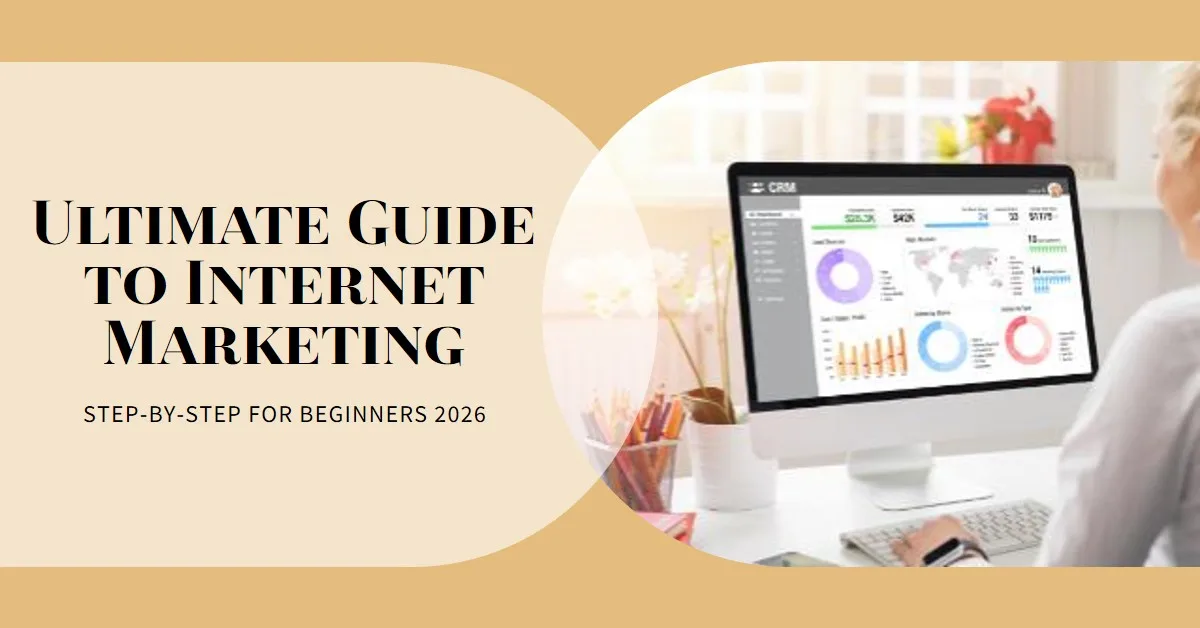
The world has moved online. And if your business hasn’t followed, you’re leaving money on the table. Whether you’re launching a new brand, growing a side hustle, or scaling an existing business, this ultimate step-by-step guide to internet marketing for beginners (2026 Edition) is exactly what you need. Internet marketing is no longer optional. It’s the engine that drives modern business growth. The good news? You don’t need a marketing degree to get started. You need the right roadmap. This guide will give you that — from the very basics to advanced strategies that actually work in 2026.
What Is Internet Marketing?
Internet marketing is the process of promoting products or services online. It uses digital channels to reach potential customers. These channels include search engines, social media, email, websites, and paid advertising.
Internet marketing is also known as digital or online marketing. All three terms mean roughly the same thing. The goal is simple: attract the right people, convert them into customers, and keep them coming back.
What makes internet marketing so powerful is its scale. A small business in Manchester can reach customers in Melbourne. A solo entrepreneur can compete with large corporations. The playing field has never been more level.
In 2026, internet marketing has evolved significantly. Artificial intelligence, short-form video, and voice search have transformed how brands connect with audiences. But the core principles remain the same. Understand your audience. Deliver value. Build trust. And measure everything.
Why This Guide Is Different
There are thousands of internet marketing guides online. Most of them are either too technical or too vague. This guide is different. It’s written for real beginners. Every strategy here is actionable. Every step is explained clearly. No jargon. No fluff. Just practical guidance you can use today.
By the end of this guide, you’ll understand every major branch of internet marketing. You’ll know which strategies to prioritise first. And you’ll have a clear action plan to start driving results.
Let’s begin.
Step 1: Understand Your Target Audience
Before you market anything, you need to know who you’re marketing to. It is the foundation of all successful internet marketing. Skip this step, and everything else becomes guesswork.
What Is a Target Audience?
Your target audience is the group most likely to buy from you. They share common traits. These might include age, gender, location, income, interests, or problems they need solving.
The more clearly you define your audience, the more effective your marketing will be. Vague targeting leads to wasted time and money. Specific targeting leads to results.
How to Define Your Audience
Start by answering these questions:
- Who has the problem my product or service solves?
- How old are they? Where do they live?
- What do they read, watch, and search for online?
- What are their biggest frustrations and goals?
- What objections might they have to buying?
Once you have clear answers, create a buyer persona. It is a fictional profile of your ideal customer. Give them a name, a job, a lifestyle, and a problem. This persona guides every marketing decision you make.
Tools to Research Your Audience
You don’t have to guess. Use these free and affordable tools:
- Google Analytics — See who’s already visiting your website
- Facebook Audience Insights — Explore demographic and interest data
- Reddit and Quora — Read real conversations your audience is having
- AnswerThePublic — Discover the questions people are searching for
- Google Trends — Track what topics are growing in popularity
Understanding your audience is not a one-time task. Keep revisiting it as your business grows. Your audience will evolve, and your marketing should evolve with it.
Step 2: Build a Professional Website
Your website is your digital home base. All roads in internet marketing lead back to it. Social posts, emails, ads, and search results all drive traffic to your website. So it needs to make a strong first impression.
What Makes a Good Website?
A great website for beginners has five essential qualities:
1. Speed. Slow websites lose visitors. Aim for a load time under three seconds. Use tools like Google PageSpeed Insights to test and improve your site speed.
2. Mobile-friendliness. Over 60% of web traffic now comes from mobile devices. Your site must look and work perfectly on smartphones. Most modern website builders handle this automatically.
3. Clear navigation. Visitors should find what they need in seconds. Use a simple menu. Keep your pages logically organised.
4. A strong call to action (CTA). Every page should guide visitors toward a specific next step. That might be signing up for your email list, booking a call, or making a purchase.
5. Trust signals. Include testimonials, reviews, security badges, and a professional design. People need to trust you before they’ll buy from you.
Best Website Platforms for Beginners
- WordPress.org — Most flexible and scalable option. Best for long-term growth.
- Shopify — Ideal if you’re selling physical or digital products.
- Squarespace or Wix — Great for simple websites with minimal technical setup.
- Webflow — A step up in design quality with more control.
Must-Have Website Pages
Every beginner’s website should include:
- Home page — Clear headline, value proposition, and CTA
- About page — Your story, mission, and why customers should trust you
- Services or Products page — What you offer and how it helps
- Blog — Drives organic search traffic (more on this in Step 4)
- Contact page — Make it easy for people to reach you
Don’t overthink your first website. A clean, fast, simple site beats a complex, slow one every time. Launch it and improve it as you go.
Step 3: Master Search Engine Optimisation (SEO)
SEO is one of the most valuable skills for beginners in internet marketing. It’s the process of getting your website to appear in Google search results. When done right, SEO brings you free, consistent traffic from people actively searching for what you offer.
How Does SEO Work?
Google uses a complex algorithm to rank websites. It looks at hundreds of factors. But for beginners, the three most important ones are:
- Relevance — Does your content match what the searcher is looking for?
- Authority — Do other reputable websites link to yours?
- Experience — Is your site fast, secure, and easy to use?
Keyword Research: The Starting Point
Keywords are the words and phrases people type into Google. Your job is to identify the keywords your target audience uses. Then create content that matches their intent.
Use these tools to find the right keywords:
- Google Keyword Planner — Free tool inside Google Ads
- Ubersuggest — Beginner-friendly and affordable
- Ahrefs or Semrush — Industry-leading tools for more advanced research
- Keywords Everywhere — A handy browser extension
Focus on long-tail keywords when starting. These are longer, more specific phrases. For example, “best running shoes for flat feet” is better than just “running shoes.” Long-tail keywords attract fewer competitors and attract more qualified visitors.
On-Page SEO Basics
On-page SEO refers to optimising individual pages on your website. Here are the key elements:
- Title tag — Include your keyword near the beginning
- Meta description — Write a compelling 150–160 character summary of the page
- Headings (H1, H2, H3) — Use them to structure your content clearly
- URL structure — Keep it short and keyword-rich (e.g., /internet-marketing-for-beginners)
- Internal links — Link to other relevant pages on your site
- Image alt text — Describe your images using relevant keywords
Off-Page SEO: Building Authority
Off-page SEO is about earning links from other websites. Google sees these backlinks as votes of confidence. The more high-quality backlinks you have, the higher you rank.
How do you get backlinks? Here are three beginner-friendly strategies:
- Guest blogging — Write articles for other websites in your niche
- Create shareable content — Infographics, original research, and tools attract links naturally
- Reach out to relevant websites — Ask them to link to your best content
SEO is a long-term strategy. Don’t expect overnight results. But once you rank, the traffic is free and consistent. That’s a massive advantage for any beginner.
Step 4: Create a Content Marketing Strategy
Content marketing is the backbone of modern internet marketing. It involves creating valuable, relevant content that attracts and engages your target audience. The goal is to educate, entertain, or inspire — and in doing so, build trust that leads to sales.
Why Content Marketing Works
People don’t like being sold to. But they love helpful information. When your brand consistently delivers value, you become the go-to resource in your niche. Trust leads to conversions. Conversions lead to revenue.
Content marketing also supports your SEO efforts. Every blog post is a new page Google can rank. And every video can drive YouTube search traffic. Every piece of content you create is a long-term asset.
Types of Content to Create
There are many content formats. The best ones for beginners include:
Blog posts — Great for SEO and educating your audience. Aim for 1,000–2,500 words per post. Focus on answering questions your audience is searching for.
Videos — YouTube is the second-largest search engine in the world. Short, helpful videos build trust quickly. You don’t need fancy equipment to start. A smartphone and good lighting are enough.
Infographics — Visual content is highly shareable. It simplifies complex information. Canva is a free tool that makes creating infographics easy.
Podcasts — A growing format in 2026. Great for building a loyal audience over time. Low barrier to entry and highly personal.
Social media posts — Short-form content on platforms like Instagram, TikTok, and LinkedIn drives awareness and engagement.
Email newsletters — One of the highest-ROI content formats available. More on this in Step 6.
How to Build a Content Plan
Start with a simple content calendar. Plan out one to two pieces of content per week. Focus on topics your audience is actively searching for. Use your keyword research to guide your choices.
For each piece of content, answer these questions:
- Who is this for?
- What problem does it solve?
- What keyword is it targeting?
- What action should the reader take next?
Consistency is more important than perfection. Publish regularly and improve as you go.
Step 5: Leverage Social Media Marketing
Social media is one of the most powerful tools for beginners in internet marketing. It gives you direct access to your audience. It costs nothing to get started. And it can produce remarkable results when used strategically.
Choosing the Right Platforms
You don’t need to be on every platform. In fact, trying to be everywhere usually leads to mediocre results everywhere. Focus your energy where your audience actually spends time.
Here’s a quick breakdown of the major platforms in 2026:
Instagram — Best for visual brands, lifestyle products, and B2C businesses. Strong for Reels and Stories. Ideal for audiences aged 18–40.
TikTok — Explosive reach through short-form video. Best for younger audiences and brands willing to be creative and entertaining. AI-assisted content creation has made TikTok marketing more accessible in 2026.
LinkedIn — The top platform for B2B marketing. Essential for coaches, consultants, agencies, and professional service businesses. Thought leadership content performs particularly well here.
Facebook — Still the largest social network. Best for community building, groups, and paid advertising. A slightly older demographic, but with enormous reach.
YouTube — Ideal for long-form educational content. SEO-friendly and builds lasting authority—a great platform for tutorials, reviews, and how-to content.
Pinterest — Excellent for niches like home decor, food, fashion, and DIY. High purchase intent from its users.
Pick one or two platforms to begin with. Master them before expanding.
Social Media Content That Performs
The content that performs best on social media in 2026 is:
- Educational — Teach your audience something useful in 60 seconds or less
- Entertaining — Make people laugh, smile, or feel something
- Relatable — Share real stories, struggles, and wins
- Controversial (in a good way) — Challenge common myths in your niche
- Interactive — Ask questions, run polls, and invite conversation
Post consistently. Engage with comments. Respond to messages promptly—social media rewards active, engaged accounts. Passive posting rarely works.
The Role of AI in Social Media Marketing (2026)
In 2026, AI tools will have made social media marketing far more accessible for beginners. Tools like Canva’s AI design features, Capcut for video editing, and scheduling platforms like Buffer and Later now include AI-generated caption suggestions and best-time-to-post recommendations. Use these tools to save time and improve output quality.
Step 6: Build an Email Marketing List
Email marketing consistently delivers the highest return on investment of any digital channel. Studies show that for every £1 spent on email marketing, the average return is £36. That’s extraordinary. And it remains one of the most beginner-friendly strategies in internet marketing.
Why Email Is So Powerful
Unlike social media, you own your email list. No algorithm controls who sees your messages. No platform can cut off your access. Your email list is a direct line to your audience. It’s one of the most valuable assets your business can have.
How to Start Building Your List
You need two things to start: a lead magnet and an email marketing platform.
A lead magnet is a free resource you offer in exchange for someone’s email address. It should solve a specific problem your audience has. Popular lead magnets include:
- Free eBooks or guides
- Checklists and templates
- Mini email courses
- Free video training
- Discount codes or exclusive offers
Email marketing platforms manage your list and send your emails. Great options for beginners include:
- Mailchimp — Free for up to 500 contacts
- Kit (formerly ConvertKit) — Excellent for content creators
- ActiveCampaign — More advanced automation features
- Brevo (formerly Sendinblue) — Affordable with strong deliverability
Writing Emails That Get Results
Every email you send should do one of three things: educate, entertain, or sell. The best email marketers balance all three. Here are some quick tips:
- Write compelling subject lines. Your subject line determines whether your email gets opened. Keep it short, clear, and curiosity-inducing.
- Write like a human, not a corporation. Conversational emails outperform formal ones.
- Always include one clear CTA. Don’t ask your reader to do five things. Ask them to do one.
- Send consistently. Whether weekly or twice a month, stick to a schedule your audience can expect.
Email marketing works best when it feels personal and relevant. Segment your list as it grows. Send different content to different groups based on their interests and behaviour.
Step 7: Run Paid Advertising (PPC)
Organic strategies like SEO and content marketing take time. Paid advertising delivers traffic immediately. For beginners, pay-per-click (PPC) advertising is one of the fastest ways to test what works and drive results quickly.
What Is PPC Advertising?
PPC means you pay a fee each time someone clicks on your ad. You set a budget. You choose who sees your ads. And you only pay when someone takes action. The two biggest PPC platforms are Google Ads and Meta Ads (Facebook and Instagram).
Google Ads for Beginners
Google Ads places your website at the top of search results. When someone searches for a keyword related to your business, your ad appears. It is incredibly powerful because you’re reaching people at the exact moment they’re looking for what you offer.
Getting started with Google Ads:
- Create a Google Ads account at ads.google.com
- Choose your campaign goal (sales, leads, traffic)
- Select your keywords using the Keyword Planner
- Write compelling ad copy with a strong CTA
- Set your daily budget and maximum cost-per-click
- Monitor performance and optimise regularly
Start with a small budget — even £5–£10 per day. Test different keywords and ad copy. Scale what works.
Meta Ads for Beginners
Meta Ads (on Facebook and Instagram) are ideal for reaching people based on their interests, demographics, and behaviours. They work particularly well for e-commerce, local businesses, and B2C brands.
The key to successful Meta Ads:
- Nail your targeting. Use detailed audience targeting to reach the right people.
- Use eye-catching visuals. In a crowded feed, your image or video must stop the scroll.
- Test multiple versions. Run A/B tests with different images, headlines, and CTAs.
- Retarget website visitors. Install the Meta Pixel on your site and show ads to people who’ve already visited. These audiences convert at a much higher rate.
Common PPC Mistakes to Avoid
- Starting with too broad a keyword strategy
- Ignoring negative keywords (terms you don’t want to trigger your ads)
- Sending traffic to a poor landing page
- Setting and forgetting — PPC needs regular optimisation.
- Not tracking conversions properly.
PPC and organic marketing work best together. Use paid ads to get quick data and traffic. Use SEO and content marketing for long-term, sustainable growth.
Step 8: Explore Affiliate Marketing and Influencer Marketing
These two channels are worth understanding as you develop your internet marketing strategy. Both can drive significant results with relatively low upfront cost.
Affiliate Marketing
Affiliate marketing is a performance-based model. You pay other people (affiliates) a commission for every sale they generate for your business. You only pay when results happen. That makes it low-risk and highly scalable.
How to set up an affiliate programme: The Ultimate Step-by-Step Guide to Internet Marketing for Beginners (2026 Edition)
- Decide on your commission rate (typically 10–30% for digital products, 5–15% for physical)
- Choose an affiliate platform — popular options include ShareASale, Awin, and Impact.
- Recruit affiliates from your existing customers, content creators in your niche, and bloggers.
- Provide them with marketing materials: banners, links, email copy
- Track performance and pay out commissions regularly
Affiliate marketing can become one of your most scalable marketing channels. But it requires active recruitment and relationship management to work well.
Influencer Marketing: The Ultimate Step-by-Step Guide to Internet Marketing for Beginners (2026 Edition)
Influencer marketing involves partnering with social media creators who have an established audience. They promote your product or service to their followers. In 2026, micro-influencers (those with 5,000–100,000 followers) often deliver better ROI than mega-celebrities. Their audiences are more engaged and more trusting.
Tips for effective influencer marketing:
- Choose influencers whose audience matches your buyer persona
- Look for genuine engagement, not just follower counts
- Give influencers creative freedom — their audience trusts their authentic voice
- Track results with unique discount codes or affiliate links
- Start with gifting before moving to paid partnerships
Step 9: Use Analytics to Track and Improve Everything
One of the biggest advantages of internet marketing is measurability. Unlike traditional advertising, you can track almost everything. Every click, every view, every conversion. This data is gold. It tells you what’s working and what to stop doing.
Essential Analytics Tools
Google Analytics 4 (GA4) — The industry-standard tool for website analytics. It tracks traffic sources, user behaviour, conversion rates, and much more. It’s free and essential.
Google Search Console — Shows you how your site is performing in Google search. Which keywords drive traffic? Which pages rank highest? And any technical issues Google has identified.
Meta Business Suite — Track the performance of your Facebook and Instagram ads and organic posts in one dashboard.
Email platform analytics — Every major email platform shows open rates, click rates, and unsubscribe rates. Use these to improve your campaigns over time.
Key Metrics Every Beginner Should Track
Don’t drown in data. Focus on the metrics that matter most to your goals:
- Website traffic — How many people visit your site each month?
- Traffic sources — Where are your visitors coming from? (organic, social, email, paid)
- Bounce rate — What percentage of visitors leave without taking action?
- Conversion rate — What percentage of visitors complete a desired action (sign-up, purchase)?
- Email open rate — Industry average is around 20–25%. Are you above or below?
- Cost per acquisition (CPA) — How much does it cost to acquire one customer?
- Return on ad spend (ROAS) — For every £1 spent on ads, how much revenue do you generate?
The Improvement Loop
Analytics only has value if you act on it. Build a simple monthly review into your routine. Ask yourself:
- Which channels drove the most traffic and conversions?
- Which content performed best?
- Where are visitors dropping off on my website?
- What should I do more of? What should I stop?
Test. Measure. Improve. Repeat. This loop is how successful internet marketers get better over time.
Step 10: Build Your Personal Brand Online
In 2026, personal branding will be one of the most powerful internet marketing strategies. People buy from people they know, like, and trust. A strong personal brand accelerates that trust-building process.
What Is Personal Branding?
Personal branding is the process of establishing yourself as a recognisable authority in your niche. It’s about consistently communicating your values, expertise, and personality across all your online channels.
Your personal brand isn’t just what you say. It’s how you make people feel. It’s the impression you leave after every blog post, social media update, podcast episode, or email newsletter.
How to Build Your Personal Brand: The Ultimate Step-by-Step Guide to Internet Marketing for Beginners (2026 Edition)
Define your niche. Don’t try to be everything to everyone. Specialise. The narrower your niche, the easier it is to stand out.
Choose your content pillars. Pick three to five topics you’ll consistently talk about. These should sit at the intersection of your expertise and your audience’s interests.
Show up consistently. Consistency builds familiarity. Familiarity builds trust. Pick your channels and post regularly. Even once a week is enough to build momentum.
Share your story. People connect with authenticity. Share your journey — including the struggles. Real stories resonate far more than polished perfection.
Engage with your community. Respond to comments. Join conversations in your niche. Show genuine interest in the people following you.
Why Personal Branding Matters for Beginners
When you’re just starting, you don’t have customer reviews or a track record. Your personal brand fills that gap. It gives people a reason to trust you before they’ve bought from you. Invest in it early, and you’ll reap the rewards for years to come.
Step 11: Stay Ahead of Internet Marketing Trends in 2026
The digital landscape evolves fast. What worked in 2022 doesn’t always work in 2026. Staying ahead of trends gives you a competitive edge. Here are the biggest shifts shaping internet marketing right now.
AI-Powered Marketing: The Ultimate Step-by-Step Guide to Internet Marketing for Beginners (2026 Edition)
Artificial intelligence has transformed internet marketing in the last two years. AI tools now assist with content creation, ad targeting, customer service, and personalisation at scale. Tools like Claude, ChatGPT, Jasper, and Midjourney help marketers produce more content, faster. But the best results still come from humans who use AI as an assistant, not a replacement. Your unique insights, experiences, and voice are still irreplaceable.
Voice Search Optimisation
Smart speakers and voice assistants are now part of everyday life. People search differently when they speak. They use natural, conversational phrases. Optimise your content for voice search by targeting question-based keywords. Structure your content with clear answers. And aim to appear in Google’s featured snippets — these are what voice assistants often read aloud.
Short-Form Video Dominance
TikTok, Instagram Reels, and YouTube Shorts continue to dominate attention in 2026. Short-form video is the single most consumed content format online. For internet marketing beginners, this represents a massive opportunity. You don’t need a production studio. Raw, authentic, helpful videos consistently outperform highly produced content on these platforms.
Privacy-First Marketing
Data privacy regulations have tightened globally. Third-party cookies are largely gone. Smart marketers are shifting to first-party data strategies — building their own email lists, communities, and data rather than relying on external platforms. It makes email marketing and community building more important than ever.
Community-Led Growth
In 2026, the community is a marketing channel. Brands that build engaged online communities — through Discord servers, Facebook groups, membership platforms, or forums — create loyal audiences that market for them. Word of mouth, referrals, and community advocacy are among the most cost-effective growth strategies available.
Step 12: Create Your 90-Day Internet Marketing Action Plan
Knowledge without action is worthless. This final step gives you a clear 90-day roadmap to put everything you’ve learned into practice.
Days 1–30: Build Your Foundation
- Define your target audience and create your buyer persona
- Choose and set up your website platform
- Install Google Analytics 4 and Google Search Console
- Identify your top 10 target keywords
- Create your lead magnet and set up your email marketing platform
- Choose your primary social media platform and optimise your profile
- Publish your first three blog posts targeting your chosen keywords
And Days 31–60: Create and Distribute Content
- Publish two blog posts per week
- Post on social media at least four times per week
- Send one email newsletter per week to your growing list
- Create one short-form video per week
- Begin outreach for one guest post opportunity
- Set up a small Google Ads or Meta Ads test campaign with a £5–£10 daily budget.
Days 61–90: Optimise and Scale
- Review your Google Analytics data — which content is getting traction?
- Double down on your best-performing channels
- Improve your top three pages based on search console data
- Begin building relationships with two or three micro-influencers in your niche
- Explore setting up a basic affiliate programme
- Set your 6-month and 12-month internet marketing goals
By day 90, you’ll have a real digital presence. You’ll have data to guide your decisions. And you’ll have a clear picture of what’s working for your specific audience and niche.
Frequently Asked Questions About Internet Marketing for Beginners
Q: How long does internet marketing take to produce results? It depends on the strategy. Paid advertising (PPC) can produce results within days. SEO and content marketing typically take three to six months to gain meaningful traction. Email marketing results compound over time as your list grows. Don’t expect overnight success, but don’t give up either. Consistency is the key.
Q: How much does internet marketing cost? You can start for almost nothing. Many of the best tools have free plans. WordPress, Google Analytics, Mailchimp, and social media platforms are all free to start. As you grow, you’ll invest in paid tools and advertising. But a beginner can get started with less than £50 per month.
Q: Do I need to be good at writing to succeed in internet marketing? Strong writing skills help. But they’re not essential. You can use AI tools to help draft content, then edit it to match your voice. You can also focus on video or podcasting if writing isn’t your strength. The most important thing is communicating clearly and genuinely with your audience.
Q: Is internet marketing the same as social media marketing? No. Social media marketing is just one part of internet marketing. Internet marketing includes SEO, email marketing, content marketing, paid advertising, affiliate marketing, and much more. Social media is a powerful channel within a broader internet marketing strategy.
Q: What is the single most important internet marketing skill for beginners? Understanding your audience. Everything else flows from this. If you know exactly who you’re talking to, what they need, and what motivates them, every other skill becomes easier. Audience research is the foundation for all successful internet marketing.
And Finally:
Q: Can I do internet marketing on my own, or do I need a team? Absolutely. Solo marketers run many successful online businesses. Focus on one or two channels to start. Master them before expanding. Use free tools and AI to increase your output. As your business grows, you can outsource or hire for the areas where you need more support.
Final Thoughts: Your Internet Marketing Journey Starts Now
Internet marketing is not a get-rich-quick scheme. It’s a skill. And like any skill, it takes time, practice, and patience to develop. But the rewards are extraordinary. A well-executed internet marketing strategy can take a business from zero to consistent revenue — without the massive budget required by traditional advertising.
This ultimate step-by-step guide to internet marketing for beginners (2026 Edition) has given you everything you need to get started. You now understand who your audience is and how to reach them. You know how to build a website, write content that ranks, use social media strategically, grow an email list, run paid ads, track your results, and build a personal brand that people trust.
The only thing left to do is start and follow The Ultimate Step-by-Step Guide to Internet Marketing for Beginners (2026 Edition)
Don’t wait until everything is perfect. It never will be. Launch your website. Write your first blog post. Record your first video. Send your first email. Take one small step today and build from there.
The internet rewards those who show up. Be consistent. Be genuine. Keep learning. And most importantly — keep going.
Your internet marketing success story starts right now.
Disclaimer:
This article is for informational and educational purposes only. Results in internet marketing vary based on effort, niche, budget, and consistency. Always conduct your own research before investing in any marketing tool or strategy.
Affiliate Links:
Some links in this article may be affiliate links, meaning they could generate compensation to us without any additional cost to you, should you choose to purchase a paid plan. These are products we have personally used and confidently endorse. Please note that this website does not provide financial advice or investment recommendations. You can review our affiliate disclosure in our privacy policy for more information.