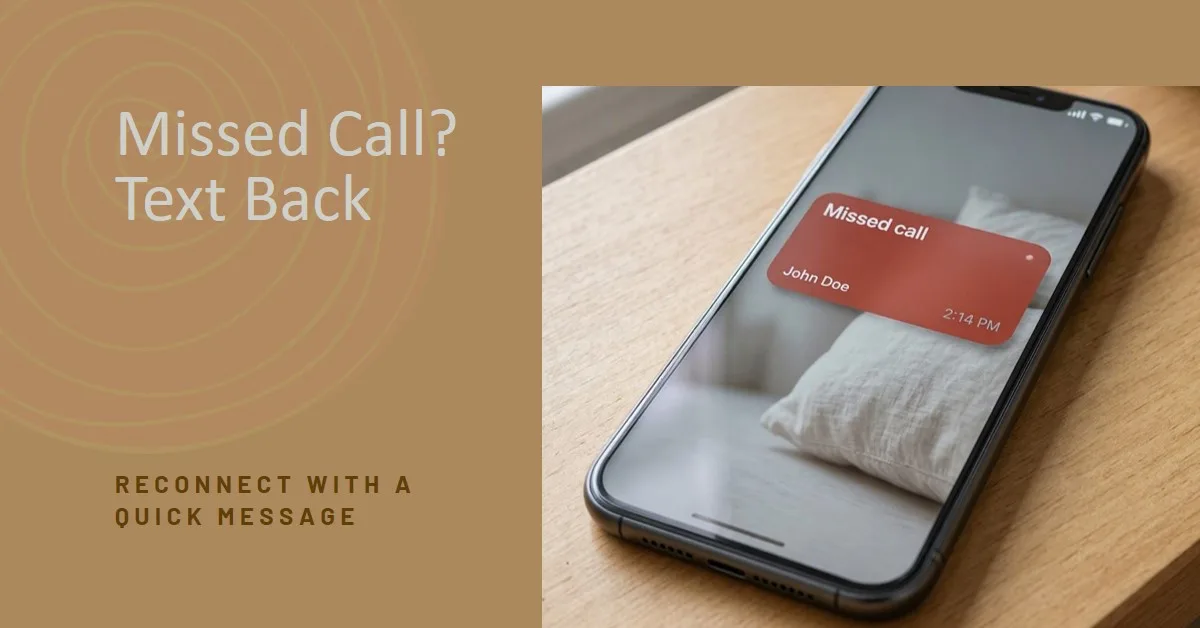
Missed call text-back is a simple tool that can recover leads and boost customer response, yet many trade businesses overlook it. Missed call text-back is one of the simplest tools available to trade businesses, and one of the most ignored. It solves a problem every HVAC, plumbing, and electrical company faces daily. Phones ring while technicians are on ladders or under sinks. Nobody answers. The caller hangs up and moves on. Missed call text back fixes this in seconds, yet most local businesses have never turned it on.
This article explains exactly what missed call text back does, why it works so well, and how pairing it with other tools can enhance your overall customer response and lead recovery efforts, empowering you to take full control of your marketing.
What Missed Call Text Back Actually Does
Missed call text back is a simple automation. When an inbound call goes unanswered, the system sends an automatic text moments later. That text tells the caller you saw their attempt to reach you and will follow up soon.
The mechanism is not complicated. Your phone system detects a missed call. It triggers a prewritten message associated with that caller’s number. The text arrives within seconds, often before the customer has even set their phone down.
This sounds small. In practice, it changes the entire experience of contacting a busy trades business. Instead of silence, the caller gets instant acknowledgement. Instead of wondering if anyone received their call, they know immediately that someone did.
Most missed-call text-back tools plug directly into existing phone lines. No new number or complicated setup is required, so many businesses can implement it within a single afternoon, making you feel capable of quick improvements.
Why So Many Trades Businesses Skip It
Given how simple and effective missed-call text-backs are, it is worth asking why adoption remains so low across the trades.
Part of the answer is awareness. Many owners have never heard of it. Marketing conversations in home services tend to focus on generating more calls through ads and SEO, rather than on what happens when those calls go unanswered.
Part of the answer is assumption. Owners often believe missed calls are rare, or that voicemail already covers the gap. Neither assumption holds up under scrutiny. Customers with an urgent problem rarely use voicemail, and missed-call rates are usually higher than owners expect once measured.
There is also a perception issue. Some owners associate automated texting with impersonal, spammy marketing. That association is understandable but misplaced. A short, honest missed call text-back message reads as attentive, not automated, when it is written well.
Many trade businesses run lean, juggling scheduling, billing, and fieldwork. Regularly reviewing and adjusting your missed-call text-back setup can help you stay effective and confident in your communication strategy.
The Real Cost of Skipping This Simple Tool
It helps to understand exactly what you lose when missed call text back sits unused.
Consider a typical HVAC company. Say ten calls go unanswered in a busy week, which is common during seasonal spikes. Without a missed-call text back, most of those callers move on to the next company on their list. A caller who cannot reach you rarely waits patiently.
Now assume your average job is worth $450, and roughly a third of missed callers would have booked if contacted quickly. That is over three lost jobs a week, worth more than $600 in a single week, and well over $30,000 across a year.
Missed call text-backs don’t eliminate this loss, but they recover a meaningful share of it. A caller who receives an instant text often waits for a follow-up call rather than dialling a competitor. That single text can be the difference between a lost job and a booked one.
Marketing spend makes this sting sharper. Many of those missed calls came from paid ads or SEO you already invested in. Losing them at the answer stage means paying twice, once for the lead and again in lost revenue. Local service businesses constantly lose leads this way, often without realising the pattern exists.
How Missed Call Text Back Actually Recovers Leads
The psychology behind missed-call text-backs is straightforward. Customers calling a trades business are usually dealing with an urgent, uncomfortable problem. A broken furnace in winter creates real anxiety. Silence after a call makes that anxiety worse.
An instant text interrupts that anxiety immediately. Within seconds, it tells the caller that a real business noticed their attempt to reach out. This alone often buys enough patience for a callback to happen before the customer moves on.
Speed is critical; a missed-call text-back starts the response clock instantly, significantly increasing the chance of converting leads.
There is also a competitive angle. Many local competitors have not adopted this tool yet. A business using missed-call text-backs stands out simply by being the one company that responded immediately, even before a human spoke to the customer. That contrast is often enough to win the job.
Writing a Message That Actually Works
The message itself matters as much as the timing. A poorly written text can undo much of the benefit.
Keep it short. Three sentences are plenty. Long automated texts read like spam, even when well-intentioned.
Use a real name. “Hi, this is Dan from Apex Plumbing” feels far more human than “Thank you for contacting us.”
Include the missed call directly in your message so customers know why they received it and feel acknowledged, which improves response rates.
Set a clear expectation. Tell them when to expect a callback, even roughly. “I’ll call you back within the hour” is more reassuring than an open-ended promise.
Avoid heavy sales language. Skip phrases like “act now” or “limited time.” Home service customers respond to helpfulness, not pressure, especially in a first message.
Here is a weak example: “We received your call. Please hold while a representative reviews your inquiry.”
Here is a stronger one: “Hi, this is Dan from Apex Plumbing. Sorry we missed your call. I’ll call you back within the hour.”
The second version sounds more human because a real name and a specific promise make it feel less automated.
Setting Up Missed Call Text Back the Right Way
Getting this running correctly takes a handful of deliberate steps, not a complicated technical project.
Choose the right platform. Many phone systems and lead management software tools include a built-in missed-call text-back feature. Check your existing CRM or phone provider before buying something new.
Write the message in advance. Draft two or three versions and pick the one that sounds most natural when read aloud. Avoid corporate phrasing entirely.
Set the trigger delay. Configure the text to send within seconds of a missed call, not minutes. Delay defeats the purpose of instant reassurance.
Route replies to a visible inbox. When a customer replies to the automated text, that reply needs to land somewhere your team actually monitors, not a channel nobody checks.
Test it yourself. Call your own business line and let it ring out. Confirm the text arrives quickly and reads the way you intended.
Review missed call volume regularly. Once the system is running, check how many calls it is catching each week. This number often reveals just how large the previous gap really was.
None of these steps requires technical expertise. Most missed-call text-back setups take under an hour once you know what to configure.
Combining Missed Call Text Back With Other Tools
Missed call text back works best as one piece of a larger system, not a standalone fix. On its own, it buys time. Paired with other tools, it closes the loop completely.
A service business CRM logs every missed call and its automated response in one place. This means no lead disappears simply because nobody remembered a call came in. The whole team can track and see everything.
An AI receptionist extends this further for after-hours calls. Instead of just sending a text, it can answer the call directly, ask basic questions, and book an appointment on the spot. This matters enormously for emergencies that happen outside business hours, when a text alone may not be enough.
Lead management software ties the whole sequence together. A missed call triggers a text, logs the lead, assigns an owner, and schedules a follow-up call, all without anyone having to manually track the process. Missed call text back becomes the first domino in a chain that ends with a booked job.
Businesses that combine these tools consistently report faster response times and higher close rates than those relying on any single fix alone. The tools reinforce each other, closing gaps that any one of them would miss on its own.
What This Looks Like in a Real Day
It helps to see missed call text back in action, not just in theory. Picture a typical Tuesday for a small plumbing company.
At 10:15 a.m., a technician is under a kitchen sink, hands full, phone buried in a truck. A homeowner calls about a slow-draining shower. It rings four times and goes to voicemail. Without a missed-call text back, that call ends there. The homeowner hangs up, feels mildly annoyed, and calls the next plumber on the list nearby.
With missed call text back running, something different happens. Within fifteen seconds, the homeowner’s phone buzzes. The message reads: “Hi, this is Maria from Clearflow Plumbing. Sorry we missed your call. I’ll call you back within the hour.” The homeowner reads it, feels reassured, and decides to wait rather than search for another company.
At 11:40 a.m., the technician finishes the job, checks the missed call log, and calls back. The homeowner answers, still expecting the call because the earlier text set that expectation. A job gets booked that would otherwise have gone to a competitor who happened to answer first.
Multiply this single interaction across a normal week. Ten or fifteen missed calls is common for a small team during busy periods. Missed call text-backs don’t save every one of those calls, but they save a meaningful share by keeping the customer waiting a little longer than they otherwise would.
Missed Call Text Back Across Different Trades
The core mechanism works the same everywhere, but the details shift slightly by trade.
HVAC companies see the sharpest seasonal spikes. Heat waves and cold snaps flood phone lines at once. Missed call text back matters most during exactly these peak weeks, when staff capacity is lowest relative to call volume.
Plumbers deal heavily with emergencies. A burst pipe cannot wait, so the reassurance of an instant text carries extra weight. Customers dealing with active water damage are especially likely to call multiple companies if nobody responds within minutes.
Electricians often handle a mix of emergency and planned work. For planned jobs like panel upgrades, the urgency is lower, but a missed-call text-back message still signals professionalism and influences which company is chosen for non-urgent work.
Garage door and locksmith services receive extremely urgent calls, often related to being locked out or stranded. These callers rarely wait. An instant text is often the only thing standing between keeping the customer and losing them entirely within the first minute.
Across every trade, the underlying principle stays constant. Speed of acknowledgement, even before a real conversation happens, shapes whether a customer stays or moves on.
Common Mistakes to Avoid
A few errors recur when businesses first set this up.
Sending a message that sounds robotic. Corporate language undoes the trust this tool is meant to build.
Forgetting actually to call back. The text buys time. It does not replace the follow-up call that needs to happen soon after.
Ignoring replies. If a customer texts back with a question, that reply needs a quick human response, not silence.
Setting the delay too long. A text that arrives ten minutes later loses much of its reassurance value.
Never reviewing performance. Missed call text back should be checked monthly like any other part of your lead process.
Frequently Asked Questions
Does a missed-call text-back cost a lot to set up? No. Many phone systems and CRM platforms include it as a standard feature. When it is a separate purchase, the cost is typically small relative to the revenue it generates.
Will customers find automated texts annoying? Rarely, if the message is short, honest, and followed by a real callback. Customers generally see it as attentive service rather than spam.
Does this replace the need to answer calls? No. Missed call text back is a bridge, not a replacement. Answering more calls directly remains the better outcome whenever possible.
How quickly should the text go out? Within seconds of the missed call, ideally under thirty seconds. Any longer and the reassurance value starts to fade.
Conclusion
Missed-call text-back is a small tool with an outsized impact. It costs little, takes under an hour to set up, and directly addresses one of the most common ways local service businesses lose leads. Most trade businesses haven’t turned it on yet, often because the problem it solves is easy to overlook until you measure it directly.
The fix is straightforward. Write a short, human message. Set it to fire within seconds. Route replies somewhere your team actually watches. Pair it with a CRM and, where useful, an AI receptionist for after-hours coverage. The leads are already calling. Missed call text-back makes sure silence never costs you the job.
Set it up once, and it keeps working quietly in the background, catching calls you would otherwise never know you lost.
Ready to Stop Losing Jobs to Silence?
If your phone rings out during busy hours and nothing happens next, you are losing calls you already paid to generate. LumenGrowth combines CRM, job scheduling, billing, and an AI receptionist into one platform built specifically for home service businesses.
Get a free lead recovery assessment today. We will show you how many calls your business is missing, what missed-call text-back could recover, and how to set it up fast. Visit lumengrowth.ai to book your free assessment now.